Auto-Update Your GitHub Profile README with GitHub Actions
Learn how to use GitHub Actions to automatically update your GitHub profile README with live stats, recent activity, blog posts, and more — no manual updates needed.
Your GitHub profile README starts as a static file. You write it once, push it, and it stays exactly as you left it — unless you manually edit it. For most sections, that is fine. But what about your latest blog posts? Your current WakaTime coding streak? Your recently starred repositories?
GitHub Actions can update your README automatically. Set up a workflow once, and your profile stays current without you touching it.
This guide covers four practical patterns for automating your GitHub profile README with GitHub Actions, from simple scheduled workflows to fetching live data from external APIs.
What You Need Before Starting
- A GitHub profile repository (
username/username) - Basic familiarity with YAML files
- A README.md in that repository
You do not need to know GitHub Actions deeply. The patterns below use workflows you can copy and adapt without understanding every line.
Pattern 1: Scheduled Workflow That Runs a Script
The simplest automation pattern: a GitHub Actions workflow that runs on a schedule, executes a script, and commits the result.
The Workflow Structure
Create .github/workflows/update-readme.yml in your profile repository:
name: Update README

on:
  schedule:
    - cron: '0 0 * * *'   # Runs every day at midnight UTC
  workflow_dispatch:        # Allows manual trigger from GitHub UI

jobs:
  update:
    runs-on: ubuntu-latest
    steps:
      - uses: actions/checkout@v4

      - name: Set up Python
        uses: actions/setup-python@v5
        with:
          python-version: '3.12'

      - name: Install dependencies
        run: pip install requests

      - name: Run update script
        run: python scripts/update_readme.py
        env:
          GITHUB_TOKEN: ${{ secrets.GITHUB_TOKEN }}

      - name: Commit changes
        run: |
          git config --global user.email "action@github.com"
          git config --global user.name "GitHub Action"
          git add README.md
          git diff --quiet && git diff --staged --quiet || git commit -m "chore: auto-update README"
          git push
The git diff --quiet check prevents empty commits when nothing changed — a crucial detail that keeps your commit history clean.
Writing the Update Script
Create scripts/update_readme.py. Here is a pattern that fetches your most recent GitHub repositories and updates a section in your README:
import os
import re
import requests

GITHUB_TOKEN = os.environ["GITHUB_TOKEN"]
USERNAME = "your-github-username"  # Replace with your username

def get_recent_repos():
    headers = {"Authorization": f"Bearer {GITHUB_TOKEN}"}
    url = f"https://api.github.com/users/{USERNAME}/repos"
    params = {"sort": "updated", "per_page": 5, "type": "owner"}
    response = requests.get(url, headers=headers, params=params)
    response.raise_for_status()
    return response.json()

def format_repo_list(repos):
    lines = []
    for repo in repos:
        if repo["fork"]:
            continue
        name = repo["name"]
        desc = repo["description"] or "No description"
        url = repo["html_url"]
        lines.append(f"- [{name}]({url}) — {desc}")
    return "\n".join(lines)

def update_readme(content, new_section):
    # Replaces content between <!-- RECENT_REPOS --> markers
    pattern = r"<!-- RECENT_REPOS -->.*?<!-- /RECENT_REPOS -->"
    replacement = f"<!-- RECENT_REPOS -->\n{new_section}\n<!-- /RECENT_REPOS -->"
    return re.sub(pattern, replacement, content, flags=re.DOTALL)

with open("README.md", "r") as f:
    readme = f.read()

repos = get_recent_repos()
repo_list = format_repo_list(repos)
updated_readme = update_readme(readme, repo_list)

with open("README.md", "w") as f:
    f.write(updated_readme)

print("README updated successfully")
In your README.md, add the markers where you want the section to appear:
## Recent Projects

<!-- RECENT_REPOS -->
<!-- /RECENT_REPOS -->
The workflow replaces everything between the markers on each run.
Pattern 2: Using Community Actions for Common Data Sources
Several high-quality GitHub Actions handle common README update patterns without you writing any code. These are the most widely used:
GitHub Readme Stats (Automatic)
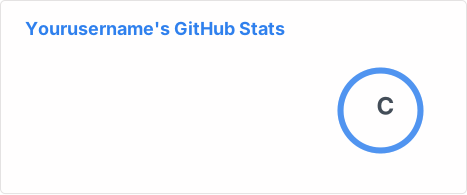
The github-readme-stats service serves stats as SVG images — they update automatically without any workflow because they fetch live data on each page load. You do not need GitHub Actions for these.
WakaTime Coding Stats
WakaTime publishes a GitHub Action that updates a README section with your coding stats:
name: Waka Readme

on:
  schedule:
    - cron: '0 0 * * *'
  workflow_dispatch:

jobs:
  update-readme:
    runs-on: ubuntu-latest
    steps:
      - uses: anmol098/waka-readme-stats@master
        with:
          WAKATIME_API_KEY: ${{ secrets.WAKATIME_API_KEY }}
          GH_TOKEN: ${{ secrets.GH_TOKEN }}
          SHOW_OS: "True"
          SHOW_EDITORS: "True"
          SHOW_LANGUAGE: "True"
This requires:
- A WakaTime account (free tier available)
WAKATIME_API_KEYsecret set in your profile repository settingsGH_TOKENpersonal access token withreposcope
Blog Posts Feed
If you have an RSS feed from a blog, the gautamkrishnar/blog-post-workflow action fetches your latest posts:
name: Latest Blog Post Workflow

on:
  schedule:
    - cron: '0 0 * * *'
  workflow_dispatch:

jobs:
  update-readme-with-blog:
    runs-on: ubuntu-latest
    steps:
      - uses: actions/checkout@v4
      - uses: gautamkrishnar/blog-post-workflow@master
        with:
          feed_list: "https://yourblog.com/feed.xml"
          max_post_count: 5
Add markers to your README:
## Latest Blog Posts

<!-- BLOG-POST-LIST:START -->
<!-- BLOG-POST-LIST:END -->
The action replaces the content between these markers with your latest posts.
Pattern 3: Fetching Data from Any External API
You can pull data from any public API into your README. Here is a pattern for displaying your recent Stack Overflow activity:
import os
import re
import requests

def get_stackoverflow_answers(user_id):
    url = f"https://api.stackexchange.com/2.3/users/{user_id}/answers"
    params = {
        "order": "desc",
        "sort": "creation",
        "site": "stackoverflow",
        "pagesize": 5,
        "filter": "withbody"
    }
    response = requests.get(url, params=params)
    response.raise_for_status()
    return response.json()["items"]

def format_answers(answers):
    lines = []
    for answer in answers:
        title = answer["title"]
        link = answer["link"]
        score = answer["score"]
        lines.append(f"- [{title}]({link}) ⬆ {score}")
    return "\n".join(lines)

# Read, update, write README using the same marker pattern
The same marker pattern (<!-- SECTION:START --> / <!-- SECTION:END -->) works for any data source. The key is keeping your update script focused on one data source per section, so failures are isolated.
Pattern 4: Matrix Workflow for Multiple Updates
If you have several sections to update, run them in parallel with a matrix strategy:
name: Update Multiple README Sections

on:
  schedule:
    - cron: '0 0 * * *'
  workflow_dispatch:

jobs:
  update:
    runs-on: ubuntu-latest
    strategy:
      matrix:
        section: [blog-posts, github-stats, stackoverflow]
      fail-fast: false   # Continue other sections if one fails

    steps:
      - uses: actions/checkout@v4

      - name: Set up Python
        uses: actions/setup-python@v5
        with:
          python-version: '3.12'

      - name: Update ${{ matrix.section }}
        run: python scripts/update_${{ matrix.section }}.py
        env:
          GITHUB_TOKEN: ${{ secrets.GITHUB_TOKEN }}

  commit:
    needs: update
    runs-on: ubuntu-latest
    steps:
      - uses: actions/checkout@v4
        with:
          ref: ${{ github.ref }}

      - name: Commit all changes
        run: |
          git config user.email "action@github.com"
          git config user.name "GitHub Action"
          git add README.md
          git diff --staged --quiet || git commit -m "chore: auto-update README sections"
          git push
Note: The commit job runs after all matrix jobs complete, collecting all changes into a single commit.
Security Considerations
GitHub Actions workflows in public profile repositories have a few security considerations worth understanding:
Use GITHUB_TOKEN when possible. The automatically provided GITHUB_TOKEN has scoped permissions and does not need manual management. For write operations to your own repository, it is sufficient.
Store API keys as secrets. Never hard-code API keys in workflow files. Use GitHub repository secrets (Settings → Secrets and variables → Actions) and reference them as ${{ secrets.YOUR_SECRET_NAME }}.
Pin action versions to full commit SHAs for workflows that handle sensitive data:
# Prefer this:
uses: actions/checkout@11bd71901bbe5b1630ceea73d27597364c9af683  # v4.2.2

# Over this (floating tag):
uses: actions/checkout@v4
Set minimal permissions. For workflows that only write to your profile repository:
permissions:
  contents: write
Adding permissions: at the top of your workflow scopes GITHUB_TOKEN to only what the workflow actually needs.
Debugging Your Workflow
When your workflow does not behave as expected:
Check the Actions tab first. Every workflow run shows detailed logs for each step. Scroll to the failing step to see the exact error.
Test with workflow_dispatch. Rather than waiting for the scheduled trigger, add workflow_dispatch: to your on: block and trigger the workflow manually from the Actions tab.
Log intermediate values. In Python scripts, add print() statements for the data you fetch before writing to the README. These appear in the Actions log and make debugging straightforward.
Check the commit step. If the workflow runs successfully but your README does not change, the commit step likely skipped because git diff detected no changes. Verify your update script is actually modifying the file.
Frequently Asked Questions
How often should I update my profile README automatically?
Daily is sufficient for most data sources. Weekly works for slower-changing content like blog posts. For stats that change constantly (like GitHub contributions), daily updates keep content fresh without excessive API calls.
Will frequent automated commits look bad on my contribution graph?
Commits from GitHub Actions bots do not appear on your personal contribution graph — they are attributed to the github-actions[bot] user, not to you. Your green squares are safe.
What if my workflow fails silently?
Add notifications to your workflow. GitHub can email you on workflow failure, or you can add a step that posts to Slack or Discord using a webhook. Configure failure notifications under Settings → Actions → General.
Can I update my README from a different repository?
Yes, but you need a Personal Access Token with repo scope instead of GITHUB_TOKEN. Store the PAT as a secret and use it in your workflow. This pattern is useful if you have a separate repository with your update scripts.
Your GitHub profile README does not have to be static. With GitHub Actions, the most dynamic parts of your profile — your latest work, your current stats, your recent writing — stay current automatically. Set it up once, and it maintains itself.
Want a strong foundation to automate? Start with a profile README that already communicates your expertise. Our AI README Generator creates the base — you add the automation on top.